
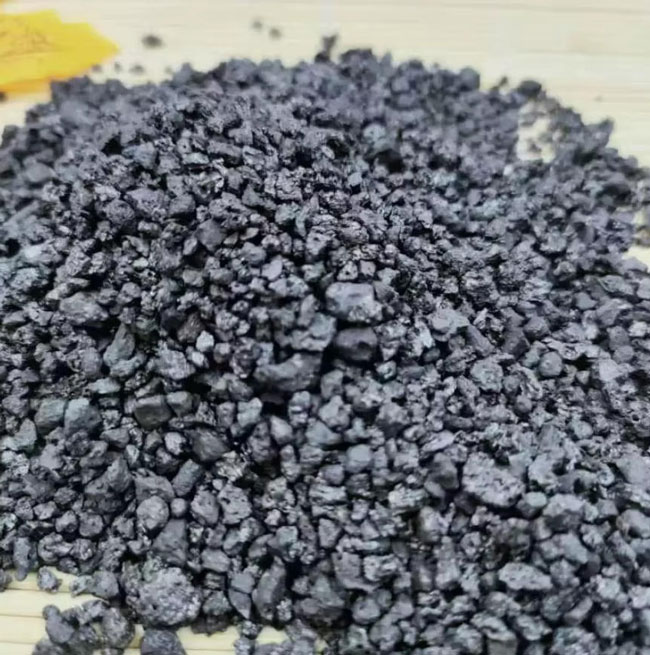
The relationship between Graphite Petroleum Coke and Carbon defines its fundamental role in metallurgy. GPC is essentially a highly purified, structurally ordered form of elemental carbon derived from petroleum residues. Unlike generic carbon black or coal coke, Graphite Petroleum Coke and Carbon interactions in molten steel are characterized by high solubility and low reactivity with oxygen. This means that when added to a furnace, the carbon atoms integrate into the iron matrix efficiently rather than burning off as CO2. The graphitic lattice structure of GPC provides stability at high temperatures, ensuring that the carbon remains available for alloying purposes. Understanding Graphite Petroleum Coke and Carbon dynamics helps engineers calculate accurate addition rates based on fixed carbon percentages, typically exceeding 98%. This high carbon availability reduces the total volume of additive needed, lowering logistics and handling costs. Moreover, the purity of the carbon in GPC minimizes the introduction of hydrogen or nitrogen, which can cause embrittlement in steel. The crystalline nature also influences how quickly the carbon dissolves; finer particles dissolve faster, while coarser ones provide sustained release. For producers, mastering the balance between Graphite Petroleum Coke and Carbon delivery is key to achieving tight chemical tolerances. Whether adjusting hypoeutectoid or hyper-eutectoid compositions, GPC offers a reliable source of pure carbon. This precision supports the manufacturing of advanced high-strength steels (AHSS) and other specialized products where exact carbon content dictates performance characteristics like hardness, toughness, and weldability.

 English
Write a Message