
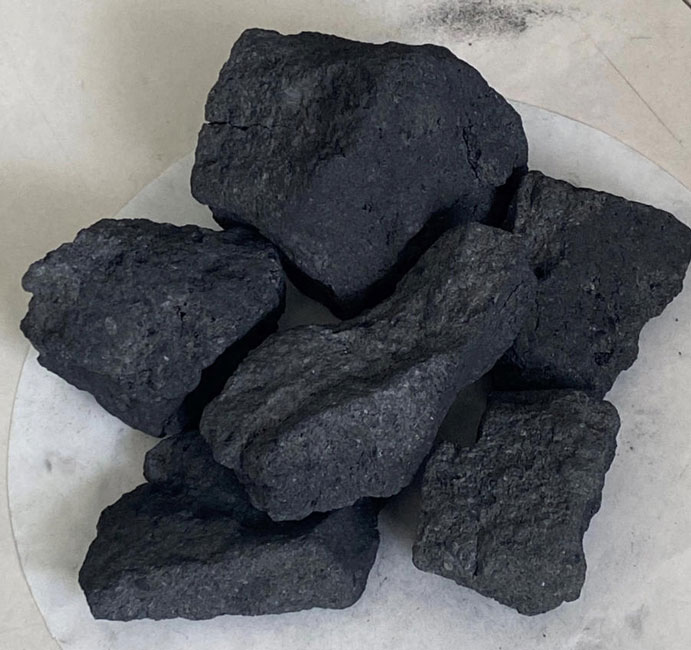
Graphite Petroleum Coke (GPC) is a carbon-rich byproduct of oil refining that can be processed to produce a range of essential industrial products, including batteries, pencils, lubricants, foundry facings and polishes, and graphite electrodes for electric arc furnaces. GPC is also critical for steelmaking, as it provides an important source of carbon during the smelting process for producing high-quality iron.
To improve the quality and energy efficiency of steel production, NETL researchers are working to develop a new, cost-effective method for making graphite from a wide variety of petroleum coke grades, enabling manufacturers to use more affordable fossil feedstocks and reduce energy costs. The technology combines iron-based catalysts and heat in a process called catalytic graphitization, which changes amorphous petroleum coke’s carbon structure into crystalline graphite, or GPC.
In the steelmaking process, GPC is used as a carbon additive to control the amount of impurities in molten iron, resulting in higher quality and strength in the final steel product. Its low sulfur and nitrogen content helps maintain optimal purity levels, while its high thermal conductivity promotes efficient heat transfer during the smelting process.
GPC is also an important ingredient in aluminum smelting applications, where it acts as a reducing agent to help remove impurities from the molten metal, thereby improving the quality and performance of finished aluminum alloys. Additionally, its high thermal conductivity allows aluminum producers to operate their smelters at lower temperatures, reducing energy consumption and improving operational efficiency.
Lastly, GPC is a key ingredient in brake pads and friction materials, where it contributes to noise reduction during braking operations by dampening vibrations between surfaces. Its high carbon content and thermal conductivity also enhance the durability and performance of these products.
While many industrial processes that use GPC are beneficial to society, there are some concerns about the environmental impact of its production and combustion. These concerns are due to the generation of fine particulate matter and greenhouse gases during GPC processing and utilization. Consequently, environmental regulatory agencies regularly monitor GPC emissions in order to ensure compliance with environmental standards and mitigate adverse impacts.
Fortunately, advances in recycling technology are helping to mitigate these concerns by diverting waste GPC from landfills and returning it back into the manufacturing process. This helps to conserve natural resources, as well as cut down on energy consumption associated with reprocessing and transporting virgin graphite. Furthermore, it also helps to boost productivity by reintroducing critical raw material inputs into the process, ultimately reducing operating costs and increasing efficiency. In addition, the use of recycled GPC helps to improve air quality by reducing carbonaceous particle and volatile organic compound emissions from the combustion and burning of fossil fuels. This is in line with the principles of the circular economy, which seeks to re-integrate waste streams into the production cycle for greater sustainability. Consequently, the adoption of this approach is expected to significantly reduce the negative impact of GPC on our planet.

 English
Write a Message