
Petroleum coke is a byproduct of the oil refining process and has a wide variety of uses. It is an essential raw material for industrial processes such as steel production, graphite electrodes and the manufacture of lithium-ion battery anodes. It has a high calorific value, low ash content, and low cost relative to coal. Its wide availability and high carbon concentration make it a valuable fuel for energy generation,2 and it is used in cement kilns and power plants. It is also a key ingredient in anodes for aluminium and titanium smelting.3 In addition, it is a raw material for the manufacture of graphite and carbon brushes used in steel mills and in the production of liquid petroleum gas (LPG).
Graphite petroleum coke is produced as blocky sponge or needle coke from delayed cokers or as shot size form from fluid bed cokers. It is calcined to produce calcined petroleum coke (CPC), which has several important applications, including manufacturing graphite electrodes, anodes and shaped products. CPC has a lower sulfur content than natural graphite and can be made into anode materials for aluminum, titanium and steel smelting, as well as into graphite for lubricants and brake linings.
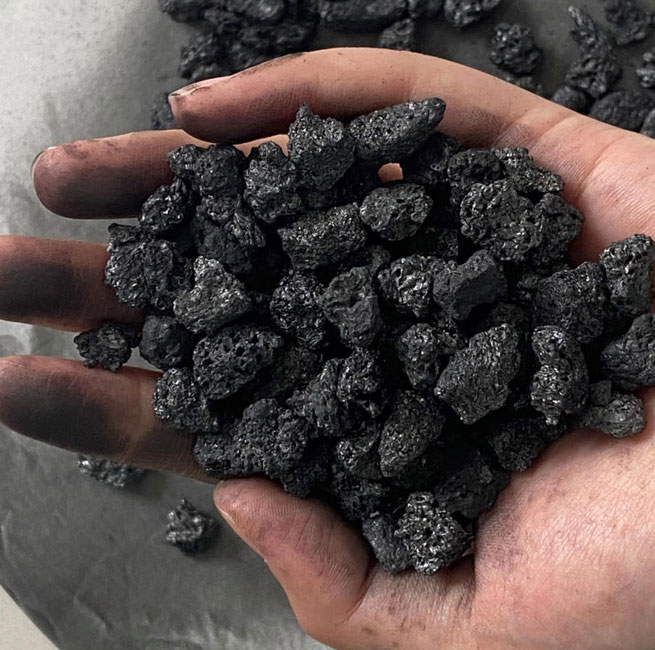
The majority of CPC is manufactured from vacuum residues in a delayed coker unit as a byproduct of crude oil refinery operations. The coke that is not calcined is called fuel coke and is used in electric arc furnaces and for cement kilns. Higher-value coke is made from the thermal cracking of higher-aromatic hydrocarbon fractions in a fluidized bed reactor, producing needle-shaped coke with a structure oriented in one direction. The highest-quality coke is known as “needle coke” and is used in the production of artificial graphite, anodes and shaped products.
Graphite and needle coke are produced by thermal decomposition of volatiles in the cracked hydrocarbon feedstock under controlled conditions. This decomposition produces carbon monoxide, carbon dioxide, and a number of byproducts, including hydrocarbons and aromatic compounds. The carbon monoxide and carbon dioxide are burned to release heat, which in turn promotes further thermal cracking of the hydrocarbons. This cycle continues until the feedstock is exhausted or reaches its cracking limit. This process can be optimized to improve product yields and to minimize energy consumption by increasing the reaction temperature or by the use of a catalyst, a chemical substance that speeds up a chemical reaction by lowering its activation barrier. The catalyst is made of a metal or carbon and is often incorporated into the reactor in which the reaction takes place, such as an electric arc furnace. This can help to reduce the amount of coke that is required for a given reaction. The resulting products have excellent electrical conductivity, which makes them ideal for high-power electrodes and anodes in Li-ion batteries.

 English
Write a Message